


We are pleased to have contributed to Global Blockchain Business Council’s 2026 edition of 101 Real-World Blockchain Use Cases Handbook (see pages 221-226).
Problem Statement
Tokenised securities are increasingly issued across multiple blockchains and legal structures, yet the market lacks a consistent way to clearly distinguish the different forms they take. Instruments that appear similar – such as tokenised shares, issuer-sponsored digital bonds, third-party issued depositary tokens, or tokenised money market fund interests – may represent fundamentally different legal rights, issuance models, and risk profiles.
Without standardised identification, market participants face difficulty understanding what a token represents, who the issuer is, and how it relates to any underlying traditional security. This lack of clarity complicates transparency, reporting, regulatory oversight, and interoperability across trading venues, custodians, and data providers.
As the tokenisation of financial instruments grow, the inconsistent usage of globally recognised identifiers risks creating fragmented data, inconsistent classification, and reduced comparability across digital instruments.
Financial identifiers provide a practical framework to bring transparency and structure to tokenised markets. By applying globally recognised identification standards, market participants can differentiate tokenised instruments based on their economic function, issuance model, and relationship to underlying assets.
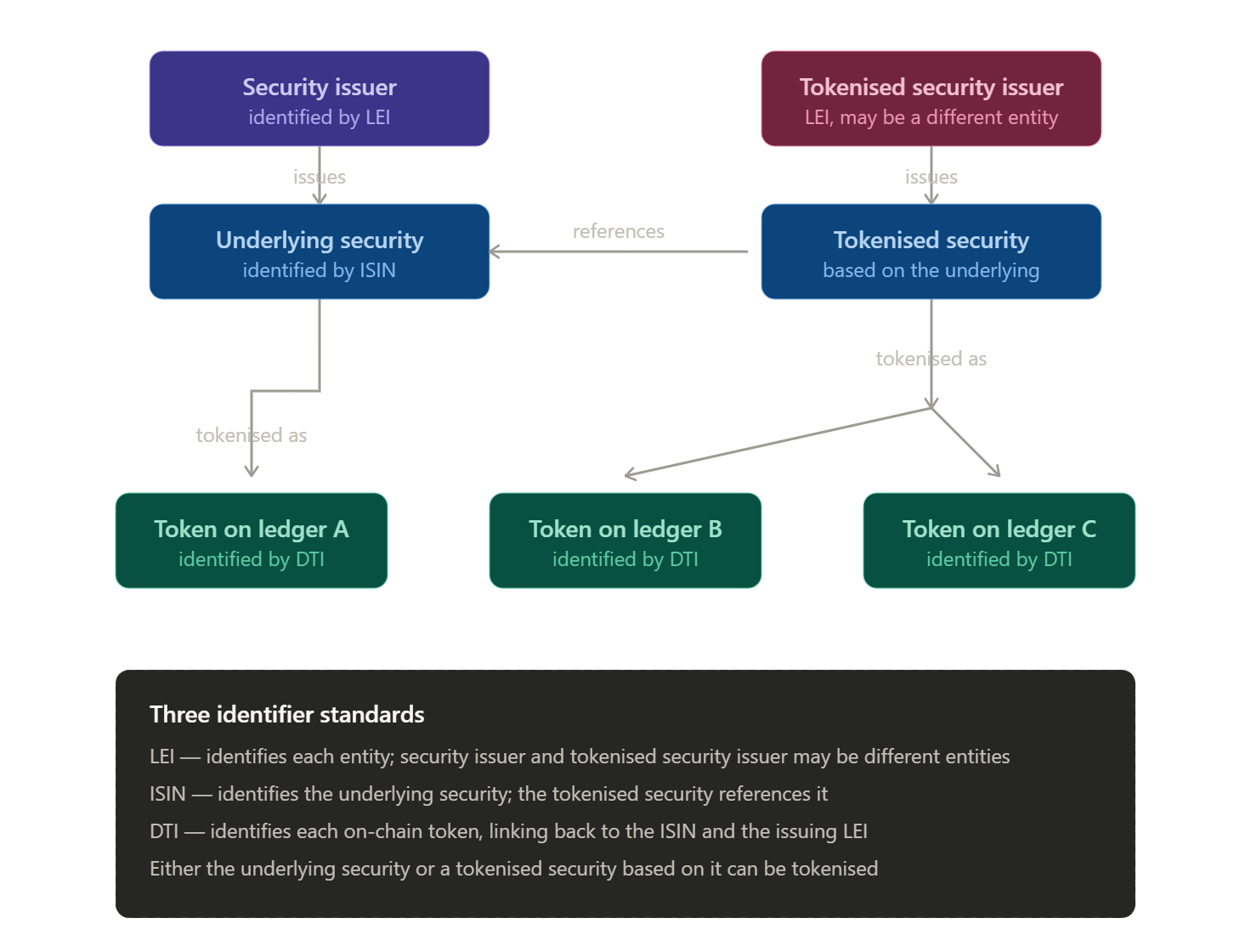
In this context, three identifiers play complementary roles:
Use Case Solution
International Securities Identification Numbers (ISINs) identify the underlying traditional security or fund. This ensures continuity between traditional capital markets and tokenised representations of those instruments.
Digital Token Identifiers (DTIs) identify the token itself as a digital asset on distributed ledger infrastructure. DTIs provide a standardised way to reference tokenised instruments across blockchain networks, trading venues, and data systems.
Legal Entity Identifiers (LEIs) identify the organisations involved in issuance, custody, and distribution, enabling clear attribution of responsibility and improving transparency around market participants.
Together, these identifiers allow market participants to distinguish between different tokenisation models. For example, they help clarify whether a token represents:
· An issuer-sponsored tokenised security – directly issued by the original issuer on-chain, evidencing a direct record of ownership of the security.
· A synthetic tokenised security – issued by a third party that provides synthetic exposure of an underlying security, but does not constitute a direct record of ownership.
· A custodial tokenised security – such as a tokenised financial instrument, where the underlying is held in custody and the token represents a claim to that security.
Using identifiers in combination creates a structured data layer that supports discovery, reporting, regulatory oversight, and interoperability between traditional and digital financial infrastructures.
Example: Alphabet Tokenised Shares
As tokenised securities evolve, this identification framework can help ensure that new digital asset instruments remain understandable, traceable, and comparable within global capital markets.
Alphabet (Google) shares are identified through ISIN US02079K3059, which has other ISO identifiers as part of the record:
- FISN: ALPHABET INC/SH CL A
- CFI: ESVUFR
- Issuer LEI: 5493006MHB84DD0ZWV18 (ALPHABET INC.)
Scenario 1: Tracker Certificates on CEXs (e.g. xStocks available on Kraken)
ISIN record CH1436219237 maintains the following through its record:
- FISN: BACKED ASSETS/STRUCT PERP GOOGL
- CFI: EYAYFS
- Issuer LEI: 984500001AB7C6C7F577 (BACKED ASSETS (JE) LIMITED)
- Underlying ISIN: US02079K3059
- DTI of implemented tokens:
- JJM522Q10 (GOOGLx on TON)
- QFZF322PK (GOOGLx on Solana)
- SWLQL6GRF (GOOGLx on Ethereum)
Scenario 2: Tracker Certificates on DeFi platforms (e.g. bStocks created by Backed Finance)
ISIN record CH1173294351 maintains the following through its record:
- FISN: BACKED ASSETS/STRUCT PERP GOOGL
- CFI: EYAYFS
- Issuer LEI: 984500001AB7C6C7F577 (BACKED ASSETS (JE) LIMITED)
- Underlying ISIN: US02079K3059
- DTI of implemented tokens:
- 3B9N4N24P (bGOOGL on Base)
- 9DLKPBWVB (bGOOGL on Gnosis)
- JTXLKDNBG (bGOOGL on Polygon)
- M2GWFH76Q (bGOOGL on Binance)
- PP92HN0P2 (bGOOGL on Arbitrum)
- R6HQ968W1 (bGOOGL on Avalanche)
- XJ1X6RKMF (bGOOGL on Fantom)
- XXG4HWN90 (bGOOGL on Ethereum)
Scenario 3: Synthetic Tokenised Shares (e.g. Stocks on Robinhood)
ISIN record XTG3MMXF50T5 maintains the following through its record:
- FISN: ALPHABET CLASS A/GOOGL
- CFI: TMXXXX
- Issuer LEI: 254900GTP4UXQO1UMI36 (Robinhood Europe, UAB)
- Underlying ISIN: US02079K3059
- DTI of implemented tokens:
- 2KX5L24VP (GOOGL on Arbitrum)
In each scenario DTI records include the link to the ISIN, LEI, and technical implementations on the relevant blockchains.
This is not an exhaustive list, new scenarios will be added to the list as they appear (e.g. Nasdaq issuer-sponsored tokenized shares). Based on the information currently available, the ISIN assigned to these tokenized shares will remain the same as that of the underlying security: US02079K3059. Once tokenization is implemented, DTI records may be introduced to enable market participants to distinguish these tokens from those created under other scenarios.

No Comments
Sorry, the comment form is closed at this time.