

Home > FAQs
First published: 27 September 2023
This set of FAQs seeks to raise market awareness on the ISO 24165 Digital Token Identifier (DTI) standard by answering fundamental questions on the nature of the identifier and its purpose, among other industry standards, to facilitate market integrity and transparency. Where feasible, the FAQs rely on definitions set out by regulatory bodies and other standard-setting authorities.
The DTI Foundation (DTIF) is a non-profit division of Etrading Software, a financial technology firm with a mission of solving market-wide problems by building market infrastructures for the new digital economy.
As Registration Authority (RA) for the ISO 24165 standard, the DTIF’s mission is to provide the golden source reference data for the unique identification of digital tokens.
DTIF issues and maintains DTIs on a non-profit, cost-recovery model, to increase transparency in the digital asset space through the creation of a core reference data set based on open data principles and available as a public good.
ISO 24165 parts 1 and 2 were developed by the ISO subcommittee SC 8 Reference data for financial services of the ISO/TC 68 Financial Services technical committee.
The DTI Foundation welcomes industry stakeholders to engage with its Product Advisory and Technical Implementation Committees. Contact [email protected] if you are interested.
A Digital Token Identifier (DTI) is a global identification system for digital tokens and is defined by the International Organisation for Standardization’s ISO 241651, published in September 2021.
A DTI comprises:
A DTI unambiguously links the relevant digital token to the distributed ledger it is deployed on.
The increasing adoption of distributed ledger technology in the traditional financial sector and the rapid growth of the decentralised crypto ecosystem have led to heightened demand by public authorities and market participants for identifying digital tokens within these networks, where they are issued, traded, settled, or stored.
DTIs are needed to provide a standardised and consistent way of identifying and referencing digital tokens across different platforms, systems, and jurisdictions.
The DTI Foundation is responsible for allocating DTI codes as the Registration Authority (RA)2 for the ISO 24165 standard.
The DTI code consists of nine alphanumeric characters with the following structure
The first eight characters are the base number.
The base number is eight characters in length but excludes vowels (A, E, I, O, U) and the letter Y (zero shall is never a first character).
The base number is randomly generated and semantically meaningless (in cases where a randomly generated identifier inadvertently appears to be semantically meaningful, DTIF would discard it).
The final character is the check character.
Key benefits include:
The scope of DTI use includes all digital assets which use distributed ledger technology for their issuance, storage, exchange, record of ownership, or transaction validation, excluding fiat currencies. Digital assets include, but are not limited to, DLT financial instruments, stablecoins, tokenised deposits, and the wider universe of crypto-assets. DTIs, for example, can be assigned to:
The DTI Registry and application process is open to all. Users include:
The party applying for a DTI code must complete the application form provided by the DTI Foundation and enclose the necessary information that is considered to be essential for allocating the DTI code. DTIs are assigned in accordance with ISO 24165-1:2021 and ISO 24165-2:2021. All registration requests submitted via the DTIF website will be verified to ensure that:
All requests are usually processed within 24 hours if all relevant information is provided.
The ISO 24165 series is organised into the following parts:
The DTI Registry is publicly available for users to search the list of all allocated DTIs.
A provisional DTI may be assigned prior to the existence of a live token. The DTI will show in the registry with a provisional status. Once live, a verification process will be conducted by the DTIF to update the status from provisional to validated. The DTI code (the unique combination of nine alphanumeric characters) will remain the same and all changes tracked through the registry. If the request is withdrawn, the DTI will be marked as deleted in the registry and the unique identifier will not be used again.
The string of nine alphanumeric characters representing a DTI cannot be changed, modified or re-used once assigned. However, it is possible to request an amendment for other reference data details for an existing record in the registry.
There are four types of DTI set out within the ISO 24165 standard.
A DTI provides linkage across three levels:
*As defined within ISO 24165 DTI standard.
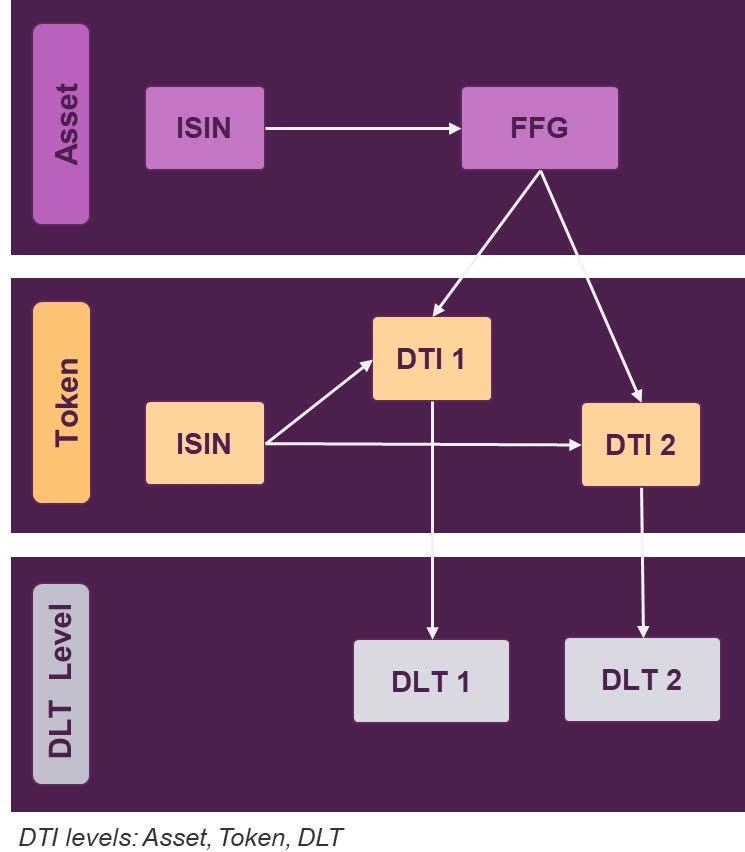
The functionally fungible group of digital tokens is a group of tokens that are accepted as equivalent in several use cases. Grouping could be created in several cases, including but not limited to the below scenarios:
The DTI complement other identifiers such as the ISO 6166 International Securities Identification Number (ISIN), ISO 4914 Unique Product Identifier (UPI) and ISO 17442 Legal Entity Identifier (LEI).
The below graph illustrates the ISO 24165 standard’s relationship with other relevant ISO standards.
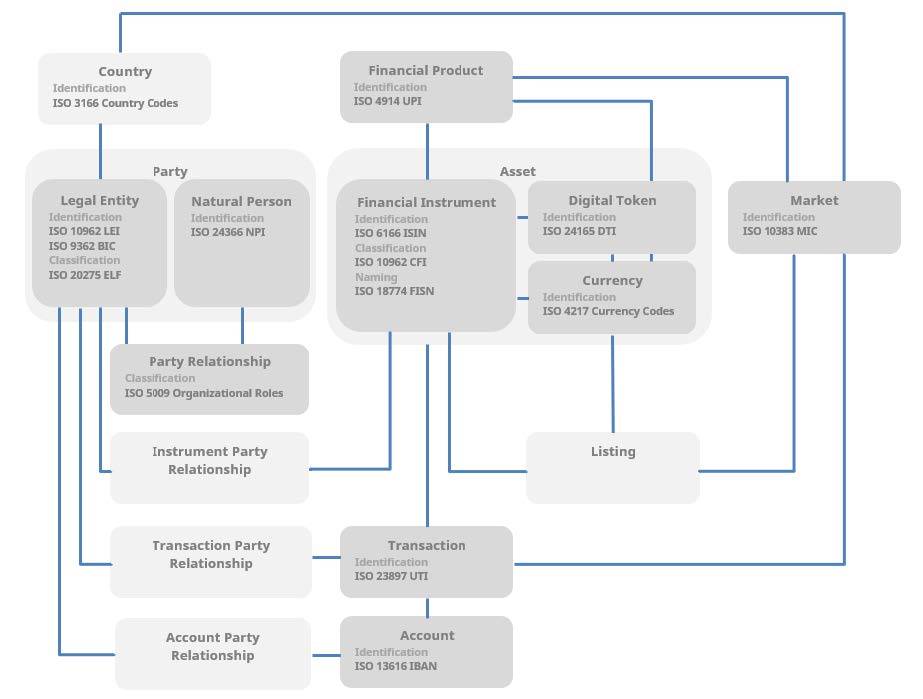
Ecosystem of ISO TC 68 Financial Services standards
An International Security Identifier Number (ISIN) is a recognised standard for identifying traditional securities, including shares, bonds, options, and other financial instruments. A Digital Token Identifier (DTI) is a recognised standard to identify digital tokens that exist on a distributed ledger.
Within traditional financial markets, ISIN and Market Identifier Code (MIC) codes identify the what and where of a transaction respectively, facilitating regulators’ ability to detect and investigate market abuse. In the crypto-asset market, a digital asset may be issued on multiple DLTs and traded or settled on multiple DLT market infrastructures. The identifiers used in traditional markets do not alone enable public authorities to identify the specific DLT on which a digital asset was issued, traded or settled. However, the DTI, as an identifier designed to cater to the specific features of the crypto-asset market, can identify the specific DLT on which a token was issued or where a transaction took place: it provides the link between the digital asset and the DLT.
For example, an ISIN would be allocated to a traditional bond. A DTI could be allocated if the bond was tokenised and represented as a token on a distributed ledger, or if the bond was natively issued on a distributed ledger. The ISIN provides a unique reference to the security, while a DTI provides a unique reference to the security token.
Additionally, DTIs could be allocated to non-financial instrument tokens such as crypto-assets or asset-referenced tokens (commonly referred to as stablecoins).
Example: ISIN-DTI Issuance – EIB Bond
In April 2021, EIB issued a digital bond on a public chain (link to press release). DTIF issued DTI WGHBLG826 for this bond, bringing together the following elements:
DTIF machine-readable reference data allows market participants and regulators to:
See the DTI Implementation guideline on the DTIF webpage.
See also: DTI Factsheet →
| Cookie | Duration | Description |
|---|---|---|
| dtif.cookie.necessary | 11 months | Necessary cookies needed for the site to function as needed. |
| dtif.cookie.viewed_policy | 1 year | Cookie which determines if we can drop our cookies into the user’s browser. |